News & Regulatory
New FDA Drug Approvals in 2026: The Full List (Updated July 2026)
The FDA has cleared roughly two dozen novel drugs in 2026 — including the first small-molecule GLP-1 pill. Here is the full list, the approvals that actually matter if you track a metabolic or peptide protocol, and what is still pending.
2026 has been a genuinely consequential year at the FDA — and not just because of volume. Roughly 22 novel drugs cleared review in the first half of the year, but the ones that will actually change day-to-day routines are concentrated in metabolic health: for the first time, the two most-prescribed weight-management molecules are available as pills, and the regulatory ground under compounded GLP-1s has shifted.
Below is the full list of 2026 FDA approvals to date, followed by a closer look at the ones that matter if you track a metabolic or peptide protocol — plus an honest status check on the two compounds this community asks about most, CagriSema and retatrutide.
How to read this page
This is an educational summary of public regulatory announcements, not medical advice and not a recommendation to start or stop anything. Approval status changes; dates and indications below reflect what was publicly announced as of July 24, 2026.
Every 2026 FDA novel drug approval so far
"Novel" approvals are new molecular entities and new therapeutic biologics that had never been approved in the U.S. before — the FDA’s own headline measure of innovation. Here is the 2026 run, in order.
| Approved | Brand | Active ingredient | Approved for |
|---|---|---|---|
| Jan 12 | Zycubo | copper histidinate | Menkes disease |
| Feb 12 | Adquey | difamilast | Mild-to-moderate atopic dermatitis |
| Feb 20 | Bysanti | milsaperidone | Schizophrenia; bipolar I manic/mixed episodes |
| Feb 23 | Loargy | spegzilarginase-nbln | Hyperargininemia in Arginase 1 Deficiency |
| Feb 27 | Yuviwel | navepegritide | Achondroplasia in children aged 2+ (accelerated) |
| Mar 17 | Lynavo | linerixibat | Cholestatic pruritus in primary biliary cholangitis |
| Mar 17 | Icoty | eicotrokinra | Moderate-to-severe plaque psoriasis |
| Apr 1 | Foundayo | orforglipron | Chronic weight management in obesity/overweight |
| May 18 | Baxfendy | baxdrostat | Hypertension (first-in-class aldosterone synthase inhibitor) |
| May 22 | Hepcludex | bulevirtide-gmod | Chronic hepatitis delta (accelerated) — first ever |
| May 27 | Decnupaz | pivekimab sunirine-pvzy | Blastic plasmacytoid dendritic cell neoplasm |
| May | Veppanu · Beqalzi · Zaynich · Cypsedo · Xocova | — | Breast cancer · mantle cell lymphoma · complicated UTI · general anesthesia · COVID-19 post-exposure prophylaxis |
| Jun 26 | Lumvoa | veligrotug-vvze | Thyroid eye disease (IGF-1R inhibitor) |
| Jun 30 | Tregzi | Orca-T | GvHD prophylaxis in allogeneic transplant |
| Jul 7 | Trutakna | atacicept-vymj | Primary IgA nephropathy (accelerated) |
| Jul 22 | Jideytro | zidesamtinib | Previously treated ROS1-positive NSCLC |
One more approval belongs in any 2026 conversation even though it landed days earlier: the Wegovy pill (oral semaglutide 25 mg) was approved December 22, 2025 and launched in the U.S. in early January 2026. Functionally, it is a 2026 arrival.
Foundayo (orforglipron): the first small-molecule GLP-1
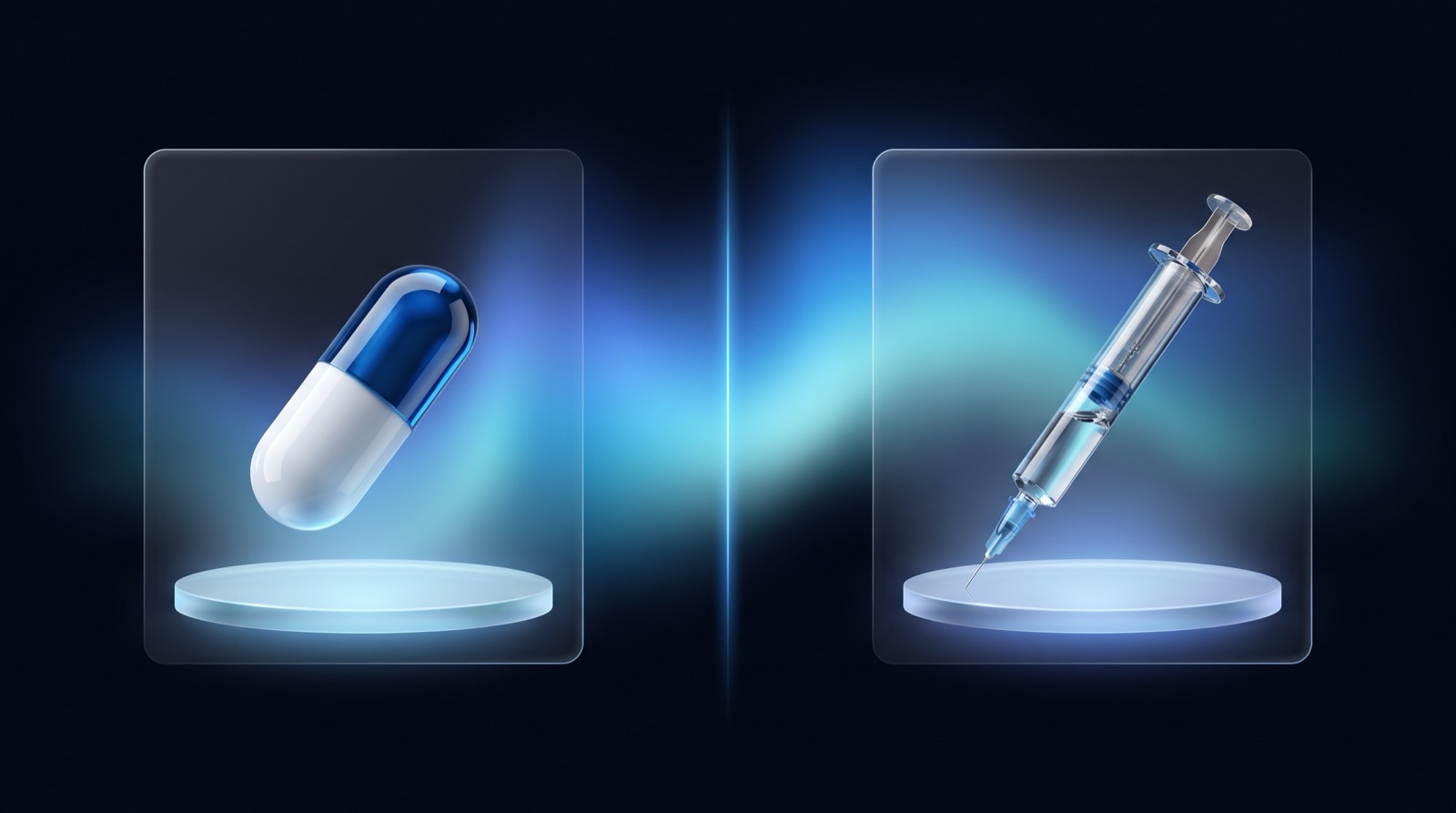
Approved April 1, 2026, Eli Lilly’s Foundayo (orforglipron) is the headline approval of the year for metabolic health. Every GLP-1 receptor agonist before it — semaglutide, tirzepatide, liraglutide — is a peptide. Orforglipron is not: it is a small molecule, which is why it survives the gut without the absorption enhancer and rigid dosing ritual that oral semaglutide requires.
The practical consequence is the marketing line, and it is a real one: any time of day, with or without food or water restrictions. Oral semaglutide must be taken on an empty stomach with a small sip of water, followed by a 30-minute wait before eating, drinking, or taking anything else. Orforglipron drops that requirement entirely.
What the trials showed
Approval rested on the Phase 3 ATTAIN-1 and ATTAIN-2 trials. In ATTAIN-1, participants on the highest dose who stayed on treatment lost an average of 27.3 lb (12.4% of body weight), versus 2.2 lb (0.9%) on placebo.
That is meaningfully below injectable tirzepatide territory and below oral semaglutide’s OASIS 4 result — a trade of peak efficacy for convenience and, likely, supply. Small molecules are far cheaper to manufacture at scale than peptides, which is the quiet story behind the pricing: eligible Medicare Part D patients were slated to access it for about $50 per month starting July 1, 2026.
It carries the class boxed warning for thyroid C-cell tumors, including medullary thyroid carcinoma, and is contraindicated in anyone with a personal or family history of MTC or MEN 2.
The Wegovy pill (oral semaglutide 25 mg)
Approved December 22, 2025 and on U.S. shelves from early January 2026, the Wegovy pill was the first oral GLP-1 approved for weight management. In the OASIS 4 trial, once-daily oral semaglutide 25 mg produced 16.6% mean weight loss among participants who adhered to treatment, with roughly one in three losing 20% or more — essentially matching injectable Wegovy 2.4 mg.
The catch is the ritual. Fasted dosing, plain water only, 30-minute wait. Adherence is not a footnote with this drug; it is the mechanism. Which is exactly why logging every dose — and specifically whether each one was taken correctly — matters more with an oral GLP-1 than with a weekly injection.
| Wegovy pill | Foundayo | Injectable GLP-1s | |
|---|---|---|---|
| Molecule type | Peptide (semaglutide) | Small molecule | Peptide |
| Frequency | Once daily | Once daily | Once weekly |
| Timing rules | Fasted, water only, wait 30 min | None | None |
| Trial weight loss | 16.6% (OASIS 4, adherent) | 12.4% (ATTAIN-1, top dose) | Up to ~20%+ depending on agent |
| Approved | Dec 22, 2025 | Apr 1, 2026 | 2021–2023 |
The peptide approvals of 2026
Two 2026 approvals are genuine peptide therapeutics — worth knowing precisely because they show what the approved end of the peptide spectrum looks like.
Yuviwel (navepegritide) — February 27, 2026
A once-weekly subcutaneous C-type natriuretic peptide (CNP) analog from Ascendis Pharma, granted accelerated approval to increase linear growth in children aged 2 and older with achondroplasia and open epiphyses. It works by counteracting the overactive FGFR3 signaling that constrains bone growth. In the Phase 3 ApproaCH trial, annualized growth velocity was 5.9 cm/year versus 4.4 cm/year on placebo.
Hepcludex (bulevirtide-gmod) — May 22, 2026
A lipopeptide entry inhibitor and the first treatment the FDA has ever approved for chronic hepatitis delta virus infection — the most severe form of viral hepatitis. Long available in Europe, its accelerated U.S. approval closes a decades-old treatment gap.
Approved ≠ what most people mean by "peptides"
Nearly every compound in the LynkDose peptide library — BPC-157, TB-500, ipamorelin and the rest — has no FDA approval for human use, and 2026 did not change that. The library is educational: it explains what each compound is and how it is discussed, not whether it is approved or advisable.
The regulatory shift that affects the most people: compounded GLP-1s
No approval in 2026 will touch as many people as a rulemaking that is not an approval at all. On April 30, 2026, the FDA proposed excluding semaglutide, tirzepatide, and liraglutide from the 503B bulks list — concluding there is no clinical need for outsourcing facilities to compound them from bulk drug substance.
The context: the FDA declared the tirzepatide shortage resolved in October 2024 and the semaglutide shortage resolved in February 2025. With no shortage and no place on the bulks list, the legal footing for large-scale compounded GLP-1s largely disappears. The comment period was extended to July 30, 2026, so no final determination has been published yet.
Worth separating from the other compounding story running the same week: on July 23–24 an FDA advisory panel voted in favor of adding BPC-157, TB-500 and five more peptides to the 503A bulks list — a different list, a different facility type, and moving in the opposite direction.
If it is finalized, mass-scale compounding of these three molecules by outsourcing facilities would be permanently off the table. Anyone currently on a compounded GLP-1 has a straightforward reason to keep a clean, dated record of dose, source, and response — because a switch to a branded product is a protocol change worth measuring against a documented baseline, not a vague memory.
What is still pending: CagriSema and retatrutide

CagriSema — filed, under review
Novo Nordisk submitted the NDA for CagriSema (cagrilintide 2.4 mg + semaglutide 2.4 mg) on December 18, 2025, with FDA review running through 2026. It would be the first once-weekly GLP-1 + amylin analogue combination approved for weight management. In the pivotal REDEFINE 1 trial it produced roughly 22.7% mean weight loss at 68 weeks, with 91.9% of participants losing at least 5% of body weight versus 31.5% on placebo. See our CagriSema overview for how the two components differ.
Retatrutide — still Phase 3
Retatrutide is not FDA approved, and as of July 2026 no NDA filing or decision date has been announced. The triple GLP-1/GIP/glucagon agonist has posted the strongest weight-loss numbers of any investigational obesity drug in Phase 3 TRIUMPH readouts, with further trials reporting through 2026 — but strong data is not approval. Realistically, an approval is a 2027-or-later question.
That distinction matters. Anything sold as retatrutide today is unapproved material outside the regulated supply chain, with no assurance of identity, purity, or concentration. Our retatrutide library entry covers what the compound is; it does not endorse using it.
What these approvals change about tracking
Two approvals in seven months moved GLP-1 therapy from a weekly injection to a daily pill — and daily oral dosing breaks most of the habits built around weekly protocols.
- Frequency changes everything. A weekly injection is a calendar event you remember. A daily pill is a habit you forget. Missed-dose patterns only show up if something is counting.
- Adherence quality is now a data point. With oral semaglutide, "took it" and "took it correctly" are different outcomes. Log the conditions, not just the dose.
- Switching creates a before/after. Injectable to oral, compounded to branded, semaglutide to orforglipron — every switch is only interpretable against a documented baseline of weight, side effects, and energy.
- Side-effect timing shifts. GI effects that clustered around one injection day now spread across every day. A journal makes that pattern visible in weeks instead of months.
- Titration schedules multiply. Both oral agents step up in dose over time. Knowing exactly which week you are in — and what happened at the last step — is the whole game.
Track the switch, not just the dose
LynkDose logs oral and injectable protocols alike, handles titration schedules, and charts weight, sleep and HRV from Apple Health against your dose history — privately, on your device.
Download on the App StoreThe bottom line
2026’s approval list is broad — hepatitis delta, thyroid eye disease, IgA nephropathy, a first-in-class hypertension drug — but its center of gravity is metabolic. Foundayo proved a small molecule can do GLP-1 work in pill form, the Wegovy pill proved a peptide can too if you follow the rules, and the 503B proposal is quietly steering people off compounded sources and onto approved ones.
For anyone running a protocol through this, the practical takeaway is unglamorous: more options and more switching means more variables, and variables you do not record are variables you cannot learn from. We will update this page as the rest of 2026 lands.
Frequently asked questions
How many drugs has the FDA approved in 2026?
Through the first half of 2026 the FDA’s Center for Drug Evaluation and Research cleared roughly 22 novel drugs — new molecular entities and new therapeutic biologics that had never been approved in the U.S. before. That pace is broadly in line with recent years, and more approvals have followed in July, including Trutakna (atacicept-vymj) for IgA nephropathy on July 7 and Jideytro (zidesamtinib) for ROS1-positive lung cancer on July 22.
What is the biggest FDA approval of 2026 so far?
For anyone following metabolic health, it is Foundayo (orforglipron), approved April 1, 2026 for chronic weight management. It is the first small-molecule GLP-1 receptor agonist ever approved — a once-daily pill that, unlike the oral semaglutide tablet, does not require you to take it at a fixed time or fast around the dose.
Is retatrutide FDA approved in 2026?
No. As of July 2026 retatrutide is still an investigational Phase 3 compound with no approved indication, no submitted NDA that Lilly has announced, and therefore no FDA decision date. It is not legally available as a prescription medicine in the U.S., and anything sold as retatrutide today is unapproved research material.
Has CagriSema been approved by the FDA?
Not yet. Novo Nordisk submitted the New Drug Application for CagriSema (cagrilintide 2.4 mg + semaglutide 2.4 mg) on December 18, 2025, and the FDA review is running through 2026. If it clears, it would be the first once-weekly GLP-1 and amylin analogue combination approved for weight management.
Are compounded semaglutide and tirzepatide still legal in 2026?
The picture has narrowed. On April 30, 2026 the FDA proposed excluding semaglutide, tirzepatide, and liraglutide from the 503B bulks list, concluding there is no clinical need for outsourcing facilities to compound them from bulk drug substance. The comment period was extended to July 30, 2026, so a final determination has not been issued. Both shortages were already declared resolved — tirzepatide in October 2024 and semaglutide in February 2025 — which removed the shortage-based justification for large-scale compounding.
Which peptide drugs did the FDA approve in 2026?
Two stand out. Yuviwel (navepegritide), approved February 27, 2026, is a once-weekly C-type natriuretic peptide analog for children with achondroplasia. Hepcludex (bulevirtide-gmod), approved May 22, 2026, is a lipopeptide entry inhibitor and the first treatment ever approved for chronic hepatitis delta. Both are prescription therapies with defined indications — not the research peptides discussed in the wider community.
Your peptide tracker, done right
LynkDose logs every dose, manages your vial inventory, rotates injection sites, and charts your results against HealthKit data — all private and on-device.
Download LynkDose Free